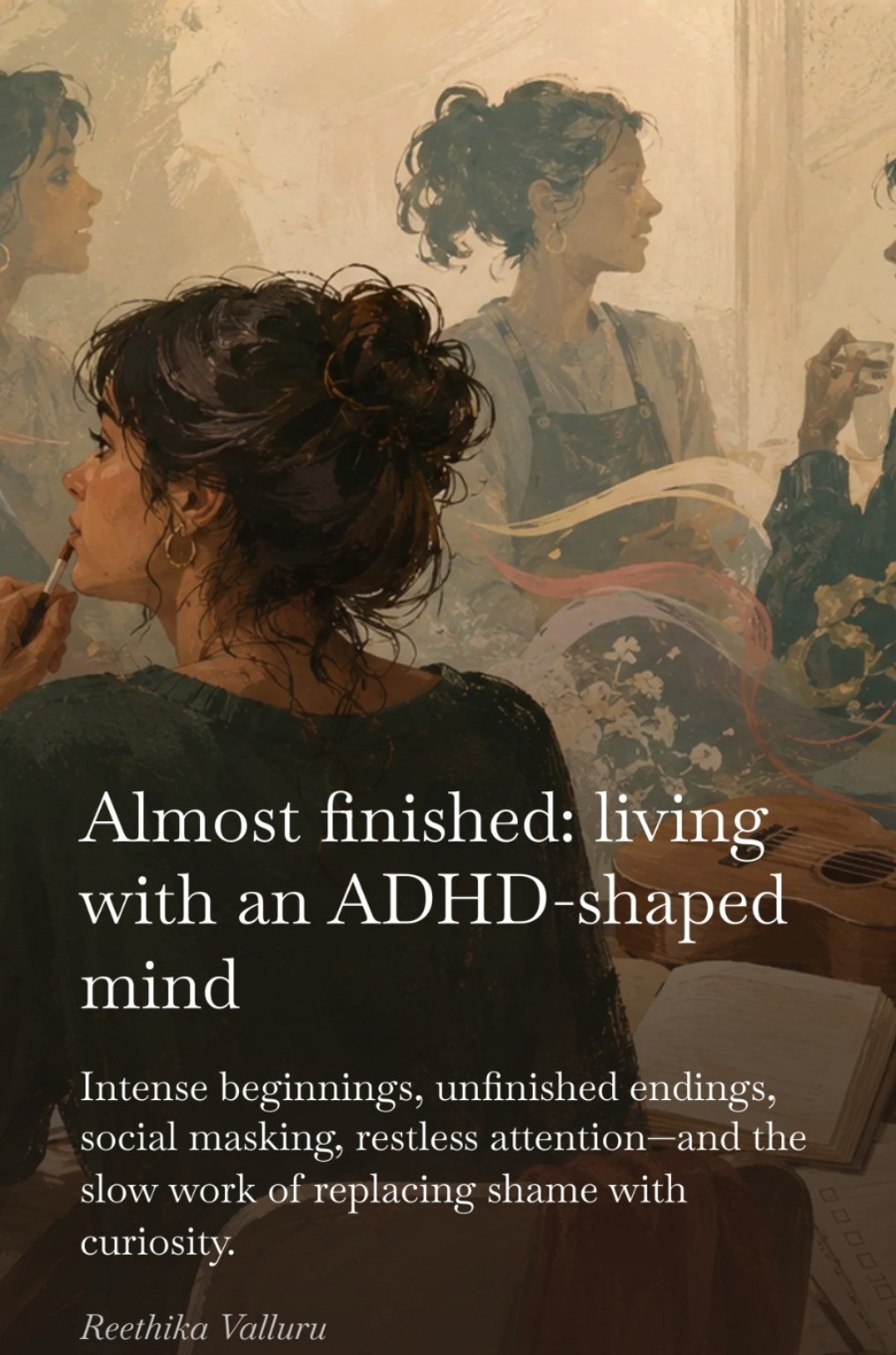
I've never been officially diagnosed with ADHD, so I can't say with any certainty that I have it. I realise these experiences can also be explained in other ways. But when you've lived with certain patterns for long enough, you begin to realise that your mind might work differently.
To me, life is a series of exciting beginnings.
I tend to jump from one hobby to another. I get interested in something, take a few classes and learn enough to become pretty good at it. Then, all of a sudden, I lose interest. Once the excitement fades and things start repeating themselves, continuing feels almost impossible.
It's not that I hate the hobby. I'm just tired of the routine around it.
The final five percent
This pattern also shows up in larger projects. I can finish 90 or even 95 percent of something and then simply leave it alone. Somehow, the final five percent feels heavier than the other ninety-five. I get lost in something completely new while the unfinished project sits untouched for weeks.
To-do lists are supposed to help. I make them all the time—sometimes beautifully. I download productivity apps, make plans and tell myself that this is the system that's finally going to turn my life around.
It works for a couple of days.
Then the list becomes one more thing I shy away from.
My life sometimes feels like a shelf of things that are nearly done, each one carrying the energy of who I was when I started it.
A mind that needs movement
Slow conversations can be difficult for me. When someone takes a long time to finish a sentence, my mind has already predicted where they are going. I become impatient and complete the sentence for them—not because I want to be rude, but because waiting for the words feels physically tiring.
Movies can feel the same way. If I understand the direction of the story within the first few scenes, my attention begins to disappear. I predict what will happen, become restless and watch the rest at twice the speed.
Sometimes even entertainment feels like something I am trying to survive.
My brain seems to need constant movement, novelty or intensity. When something is new, I can focus on it completely. I can spend hours researching, practising or thinking about it. But when it becomes familiar, that focus can disappear as quickly as it arrived.
Out of sight, strangely out of mind
This pattern also affects relationships in ways that are difficult to explain without sounding uncaring.
I can love someone deeply and still lose touch with them when distance enters the relationship. I become absorbed in the people, emotions and responsibilities directly in front of me. Friends from earlier chapters of my life quietly move into the background.
It is not that I have stopped caring about them. It is not even that I consciously decided to move on. I simply do not experience missing people in the way others seem to describe it. Then months pass, guilt appears, and contacting them feels harder because I do not know how to explain the silence.
How do you tell someone, “You matter to me, even though my behaviour may not always make that obvious”?
Becoming whoever the room needs
Meeting new people brings another kind of exhaustion.
I often feel like a social chameleon. In every group, I observe the personalities around me and quietly adjust myself. I become louder with energetic people, calmer with reserved people and more agreeable when I am unsure whether my real reactions will be accepted.
Perhaps everyone does this to some extent. For me, however, it can feel like switching between several versions of myself. Afterward, I wonder which version was genuine.
The answer might be that they all were. But constantly adapting takes energy. New people bring excitement, anxiety, curiosity and the pressure to fit in—all at the same time. By the end of it, I can feel emotionally full and completely empty.
The unfinished version of me
The hardest part is not any single unfinished hobby, abandoned routine or forgotten message. It is the story I begin telling myself because of them.
Why can I not be consistent?
Why do systems that work for other people stop working for me?
Why can I give something all my attention today and struggle to care about it tomorrow?
For a long time, I treated these patterns as personal failures. I thought I lacked discipline, commitment or consideration for others. I kept trying to force myself into routines designed for a mind that might not work like mine.
I am still learning the difference between recognising a pattern and diagnosing myself. Relating to ADHD experiences does not replace a professional assessment. But giving these patterns a name—even an uncertain one—has helped me approach myself with more curiosity and less shame.
Maybe I am not lazy. Maybe my attention responds differently to novelty, urgency and repetition. Maybe abandoning something at 95 percent does not erase the work it took to get there. Maybe losing touch does not mean I never cared.
I do not have a perfect conclusion or a productivity system that has finally fixed everything. Most days, I am still moving between interests, emotions, people and different versions of myself.
I am still trying to understand a mind that races ahead, gets bored quickly, feels intensely and rarely stays in one place for long.
For now, I would not call it thriving.
I would call it surviving—and slowly learning how to survive with a little more kindness toward myself.
Notes on attention, identity and learning to meet myself with more kindness.